Architecture
How it's built
In four pictures: the whole system, one failure through the pipeline, how every number on the results page is produced, and the live workflow that answers failing pull requests on two other projects. Each names the code that implements it. Select a diagram to open it full size.
The system
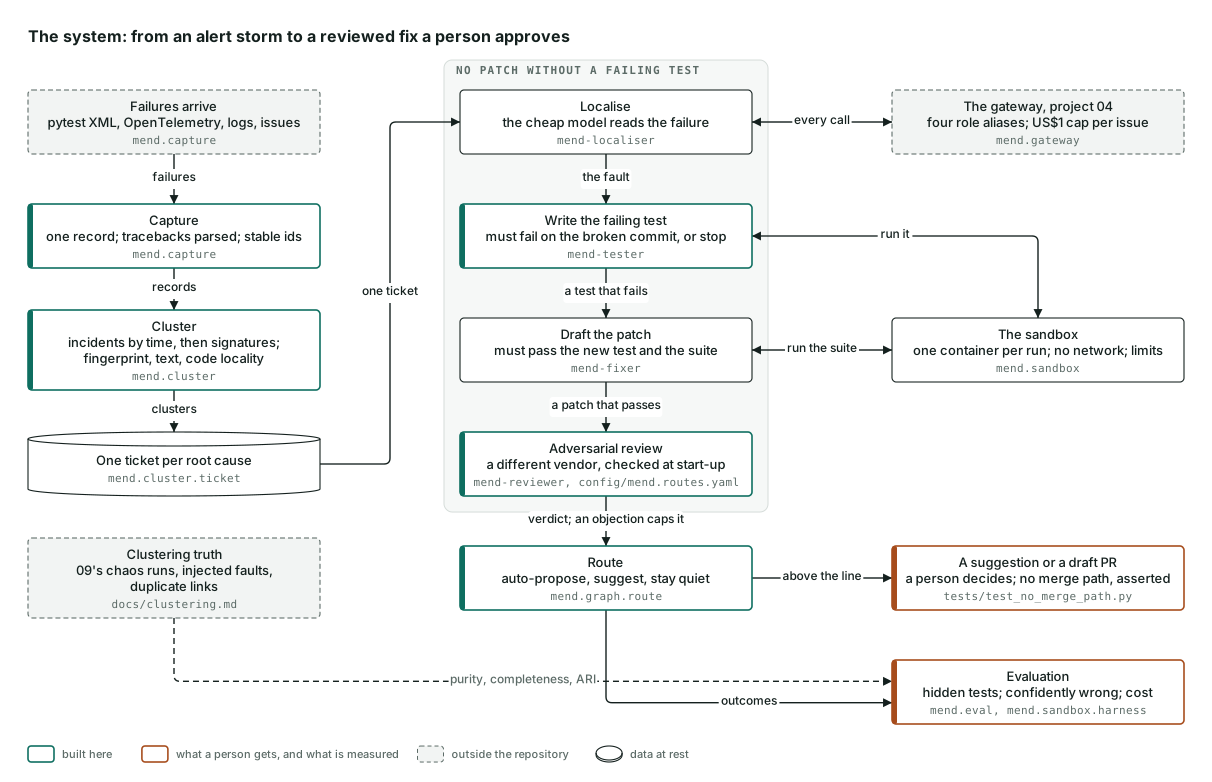
Failures arrive as pytest JUnit XML, OpenTelemetry spans and logs, or GitHub issues, and become one failure record with the traceback parsed, paths and messages normalised and a stable id, so reading a report twice cannot inflate the symptom count. Clustering turns many records into one ticket per root cause: symptoms that began together are first grouped into incidents, then incidents and tracebacks are compared by fingerprint, failure text and code locality. Its quality is measured against three labelled sets: project 09's chaos runs, injected faults and maintainers' duplicate links. The middle column is the state machine. A cheap model localises the fault; a test is written that must fail on the broken commit, or the run stops; a patch is drafted that must pass that test and the existing suite in the sandbox (one container per run, no network, limits); and a reviewer whose alias resolves to a different vendor from the fixer, checked at start-up, tries to break it. An objection caps the patch at a suggestion. The router sends what is left to a draft pull request, a suggestion or silence. There is no edge into a patch except from a failing test and no state that means merged. Every model call goes through project 04's gateway with a US$1 cap per issue, and the evaluation scores every drafted patch on the benchmark's hidden tests.
Where it lives: mend.capture, mend.cluster, mend.graph.machine, mend.graph.graph, mend.graph.route, mend.sandbox, mend.gateway, mend.eval, config/mend.routes.yaml, tests/test_no_merge_path.py.
One failure through the pipeline
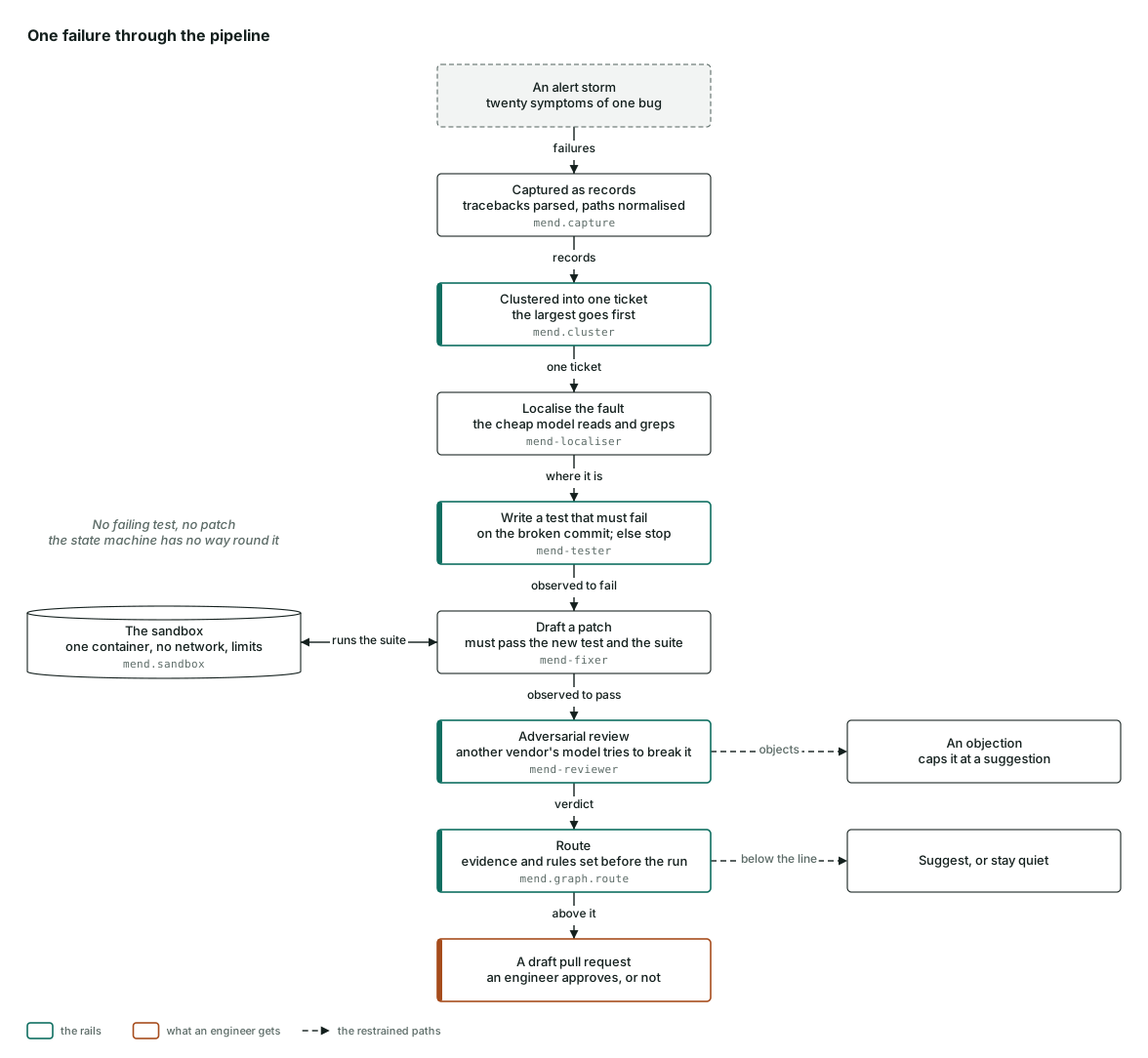
Twenty symptoms of one bug arrive, are captured as records and clustered into one ticket, and the largest ticket goes first. The localiser, the cheap model, reads the failure and searches the repository. The tester writes a test that must be observed to fail on the broken commit; if it does not, the system stops and says why, because the state machine has no way round it. The fixer drafts a patch that must pass the new test and the existing suite in the sandbox. The reviewer, a model from another vendor, tries to break it, and an objection caps the patch at a suggestion. The router reads the evidence against rules set before the run: above the line a draft pull request is opened for an engineer to approve, or not; below it the system leaves a suggestion or stays quiet.
Where it lives: mend.graph.localise, mend.graph.test_first, mend.graph.patch, mend.graph.review, mend.graph.route, mend.graph.act, mend.sandbox.workspace.
How the numbers are produced
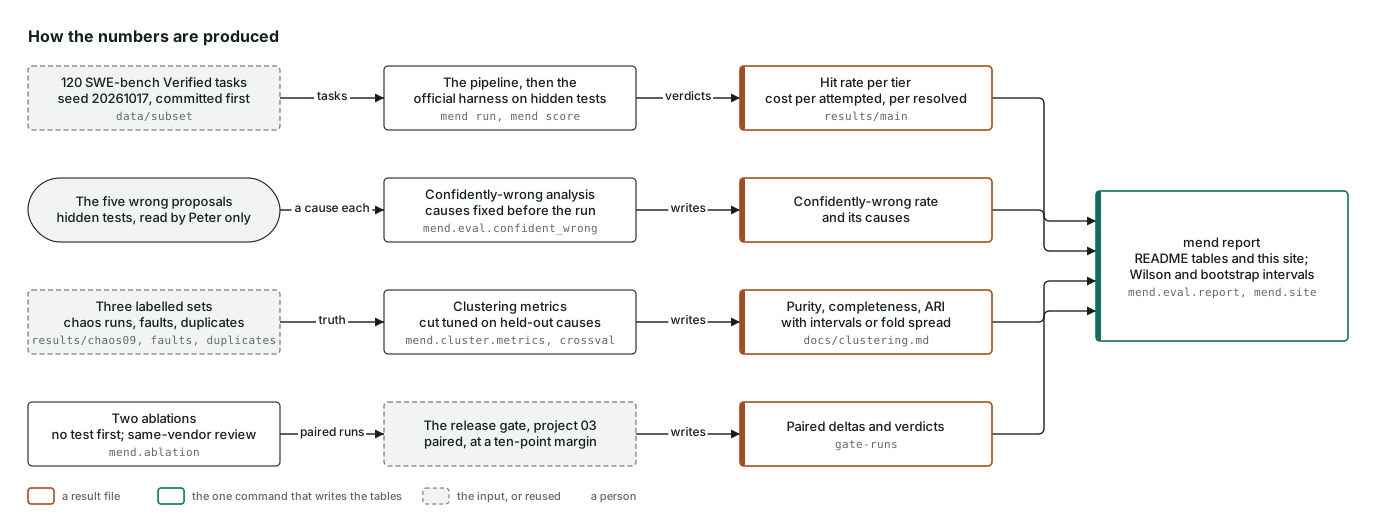
The 120 tasks were drawn from SWE-bench Verified with seed 20261017 and committed before the first run, with a separate 30 for calibrating the router. Each goes through the pipeline and then the official SWE-bench harness, which judges the patch on the benchmark's hidden tests in a Linux container; no model ever reads those tests. The outcomes give the hit rate and cost per tier. The five proposals that failed the hidden tests were classified by Peter against the maintainers' fixes, into causes fixed before the run. The clustering metrics come from tuning the cut on some causes and scoring it on causes held out. The two ablations, no failing test first and the fixer's own vendor as reviewer, go through project 03's release gate as paired comparisons. One command, mend report, writes every README table from those files, and mend site writes this site's numbers from the same files.
Where it lives: mend.data.swebench, mend.sandbox.harness, mend.eval.results, mend.eval.confident_wrong, mend.cluster.crossval, mend.ablation, mend.eval.report, mend.site.
The live workflow
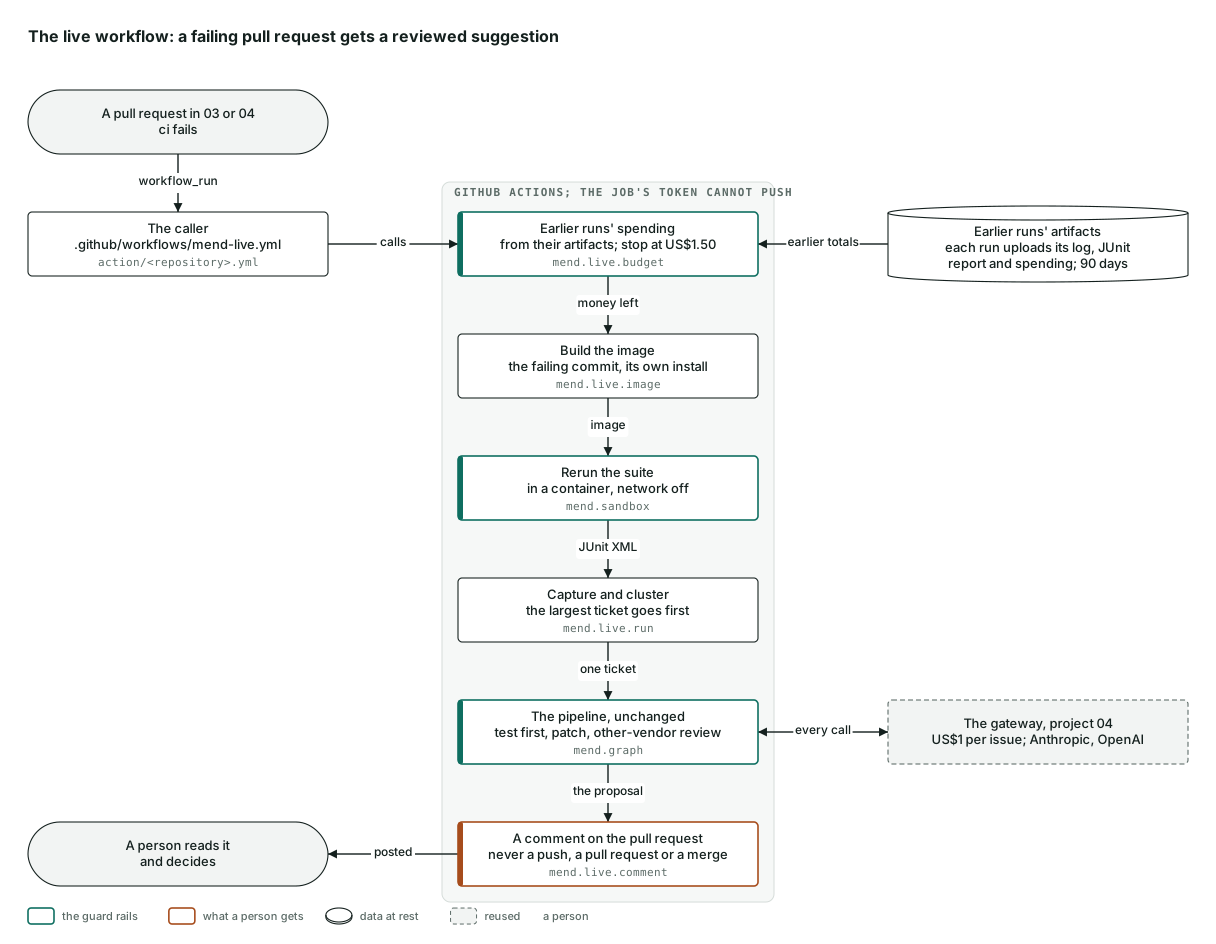
When ci fails on a pull request in project 03's or 04's repository, the caller in that repository starts the reusable workflow. It first reads every earlier run's spending from their artifacts and stops if the repository's US$1.50 is spent. It builds an image from the failing commit with the repository's own install command, the one step with network access, and reruns the suite in a container with the network off. The failures are captured and clustered, and the largest ticket goes through the same pipeline as the benchmark, every call through the gateway. The result is posted as a comment on the pull request, and the job's token cannot push, so it never opens a pull request or merges. Each run uploads its log, its JUnit report and its spending for the next run to read.
Where it lives: .github/workflows/live.yml, action/, mend.live.scope, mend.live.budget, mend.live.image, mend.live.run, mend.live.comment.